




















Wild yak — 购买或出售


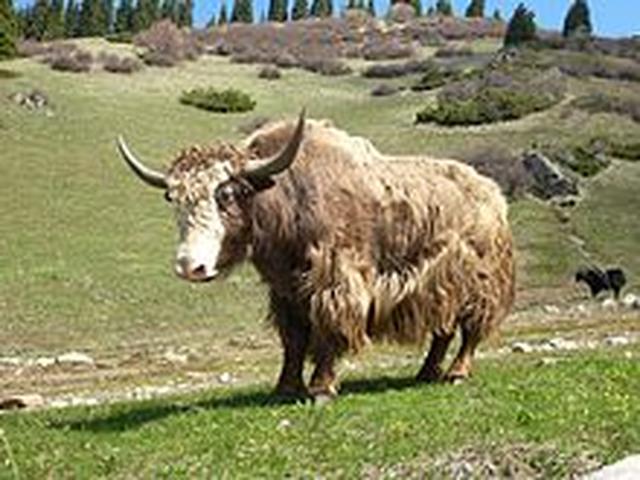
History of the breed. One of the major inhabitants of Tibet is the Wild Yak, which has served as a source of sustenance and transportation for humans for many centuries. Thanks to these unique animals, people survive in the harsh conditions of Tibet and the highlands. Nomadic herders use the milk, meat, and wool of Wild Yaks for their livelihoods. The lifespan of a Wild Yak is about 20 years, and it is a very large animal, weighing up to 1000 kg. Wild Yaks have a very rich history, belong to the family Bovidae, genus Bos, and are considered to have originated in Tibet. Yaks are divided into two large groups: domestic and wild. There is a theory that yaks and North American bison descended from a common ancestor, with Wild Yaks remaining in Western Asia while bison migrated to North America. The Tibetans refer to the Wild Yak as "drong." Tibet is a fantastically beautiful mountainous region where it is very difficult for animals to survive; the thin mountain air, low precipitation, and harsh climate create some challenges for its inhabitants. However, Wild Yaks are well adapted to living in such conditions. According to archaeological data, Wild Yaks have inhabited the mountains of Tibet, Central, and East Asia for 6000-8200 years. Today, Wild Yaks can be found at altitudes of 3000-5500 meters in Tibet, Nepal, and Central Asian countries, but they are considered extinct in Bhutan. Nowadays, the Wild Yak is classified as a vulnerable species, with preliminary data indicating that about 15,000 individuals inhabit the high-altitude regions of Tibet. Exterior. The Wild Yak looks quite unusual, with the head of a cow, the body of a bison, the tail of a horse, and the wool of a goat. Domestic yaks grunt; the fact is that they cannot moo and make sounds similar to grunting, which is why yaks are called "grunting bulls." However, Wild Yaks do not make any sounds, which is why they are referred to as "silent bulls." At first glance, this animal exudes power, with its massive, low-set head, small ears, hollow horns, muscular body covered in long hair, a hump on its back, short legs, and rounded hooves forming a very recognizable silhouette. The weight of an old male can exceed 1000 kg, while females weigh around 400 kg. The body length, excluding the tail, reaches 3.5-4.0 m, the height at the withers is up to 2 m, the shoulder height ranges from 1.37 m to 2.03 m, and the tail length is from 60 cm to 75 cm.
登录以了解更多
登录喂什么
Diet. Usually, meals occur in the morning and evening, and the animals cover large distances in search of food. Wild yaks typically feed on mosses, lichens, shrub shoots, grass, and even dried vegetation. With their horns, yaks remove the upper layer of soil, and a special shape of their lips aids in foraging for food; their lips are thin and easily allow them to dig out discovered food from under the snow. It is better not to approach during feeding, as these animals have a very temperamental nature; their nervous system is easily excitable, and a yak can become enraged over any reason. They drink water from rivers and warm springs.
物理参数
雄性体重: 160–200 公斤
雌性体重: 140–170 公斤
雄性身高: 800–1000 厘米
雌性身高: 400–650 厘米
栖息地
中国
伊朗
俄罗斯
吉尔吉斯斯坦
哈萨克斯坦
塔吉克斯坦
尼泊尔
巴基斯坦
蒙古
阿富汗
常见问题
Wild yak有多重?
成年动物:公牛 — 160–200 公斤, 母牛 — 140–170 公斤。
Wild yak有多高?
肩高:公牛 — 800–1000 厘米, 母牛 — 400–650 厘米。
Wild yak起源于哪里?
原产国 — 中国。
Wild yak在哪里饲养?
该品种分布于:中国, 伊朗, 俄罗斯, 吉尔吉斯斯坦, 哈萨克斯坦, 塔吉克斯坦, 尼泊尔, 巴基斯坦。
Wild yak吃什么?
Diet.
问答
还没有问题。第一个提问!
登录 以提问